

Last campaign, Alty retained their status in Non-League’s top division for a sixth successive season by finishing in a respectable 13th position.
Ending the season a sizeable 15 points above the dreaded dotted red line, which would’ve resulted in a return to National League North football for the first time since 2020, the Manchester-based outfit experienced a term that lacked any sort of consistency.
Only three teams accumulated less than their 17 points on their travels, a metric they’ll be desperate to improve on in time for the first fixture in August.
Since rising into the National League, Neil Gibson’s side have never finished below 17th, and even placed as high as fourth in in the 2023/24 campaign.
History
Altrincham have a rich history in Non-League football, stretching back more than 130 years.
The club’s origins began around 1891, and were initially referred to as the Rigby Memorial Club – a Sunday School Team. After merging with another local side they became Broadheath FC, before adopting the name Altrincham FC in 1903 following a migration closer to the centre of the town.
Altrincham achieved national prominence in the late 1970s and early 1980s. becoming founder members of the Alliance Premier League (the forerunner of today’s National League) in 1979 and winning the competition in its first two editions (1979/80 and 1980/81). However, because the Football League still used a re-election system rather than automatic promotion, they were denied a place in the league despite being champions.
Alty became renowned as FA Cup giant-killers during the 1970s and 1980s, building a reputation for defeating Football League outfits. In fact they eliminated EFL opposition a record 16 times for a non-league club, including a famous victory over top-flight Birmingham City in 1986.
During the 1990s, Altrincham experienced fluctuating fortunes, with several promotions and relegations between the National League and regional divisions. Following back-to-back relegations in 2016 and 2017, Altrincham quickly rebuilt under manager Phil Parkinson, winning promotion back to the National League in 2020 where they have competed ever since.
Manager – Neil Gibson
Welshman Neil Gibson occupies the dugout at the J. Davidson Stadium and is entering his first full season in charge of the Robins.
He was initially appointed as interim manager in October 2025 following the departure of long-serving manager Phil Parkinson. After an upturn in form, including a run of four victories in five games Altrincham made his appointment permanent in late November.
Before joining Altrincham, Gibson managed several clubs in Welsh football including Prestatyn Town, Connah’s Quay Nomads, enjoying a spell as Director of Football at the former between 2011 and 2014.
Captain- Tom Crawford
On matchdays, central midfielder Tom Crawford can be spotted sporting the skipper’s armband. The 27-year-old moved to Altrincham from Hartlepool United in the summer of 2024 and was awarded the responsibility of captaincy in mid-February, succeeding Lewis Baines.
A dependable force in the middle of the park, Crawford only missed two National League matches last term and has been described by his manager as “one of the first names on the team sheet”.
Since taking the armband, Crawford continued to lead by example, which included scoring the winning goal in a 1–0 win over Eastleigh in April.
Entering the prime years of his career, Crawford broke through at Chester FC before enjoying spells at AFC Fylde and Notts County.
Previous Meeting
The Rebels have never competed against Altrincham in any competition throughout history, with two meetings guaranteed to take place over the next 12 months
Stadium
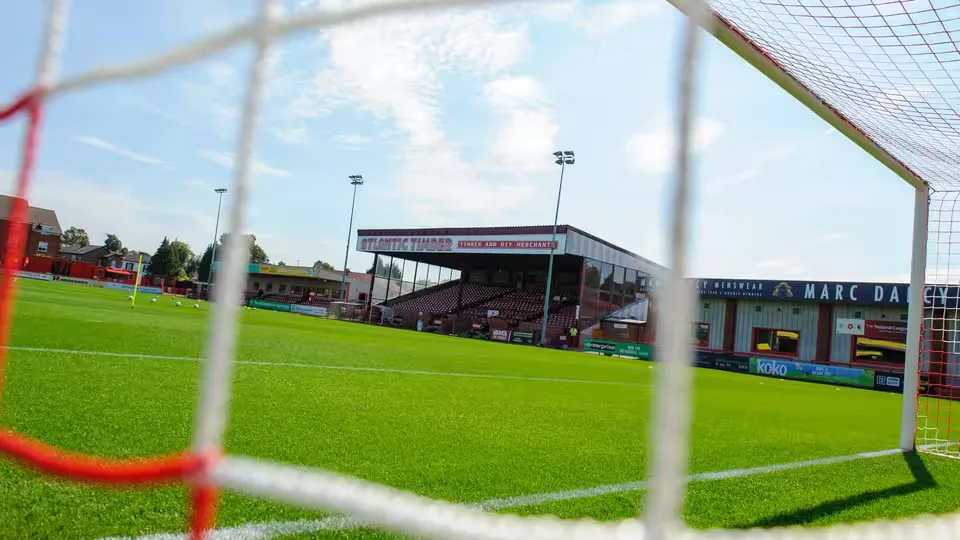
The J. Davidson Stadium, traditionally known as Moss Lane, has been the home of Altrincham FC for well over a century after moving from the nearby Pollitt’s Field in 1910.
In terms of viewing positions, the stadium has a mix of seated and standing areas, and includes the historic Main Stand, the Popular Side terrace and the Golf Road and Hale End terraces.
The ground has an official matchday capacity of around 5,450 and also features a modern Community Sports Hall, which is used by supporters and the wider local community.
Distance from the Sussex Transport Community Stadium: 249 miles
Originally published by Worthing FC ↗