
A six-year stay in the Football League came to a halt last term, as the Bluebirds propped up the League Two table. Ending the season at the bottom of the EFL standings, Barrow were only four points off safety. Only three victories since the turn of the year was a huge factor in their demise, as they dropped down the pecking order and were relegated alongside Harrogate Town.
The objective for the upcoming campaign will undoubtedly be to seal an immediate return into League Two, with the Cumbrians considered one of the early favourites to lift the league title come May.
One of the longest journeys in the league, both Barrow and Worthing will commute across the length of the country to visit each others respective grounds.
History
For the large majority of the subsequent five decades, Barrow competed in the lower divisions of the Football League. Arguably their greatest league achievement to date occurred the in the 1966/67 season, when they won promotion to the Third Division – finishing in eighth place in their debut campaign.
A major turning point in their history saw Barrow loe their Football League status after failing to secure re-election. They then spent 48 years in Non-League football, with financial struggles interspersed throughout. During this period, they became a founding member of the Alliance Premier League (now the National League) and won the prestigious FA Trophy twice in 1990 and 2010.
Barrow’s fortunes changed under manager Ian Evatt, who guided the club to the 2019/20 National League title. After flirting with the possibility of making the coveted play-off places for a couple of years, a gradual drop off has culminated with the Bluebirds returning to Non-League.
Manager – Adam Murray
It’s a new era at Holker Street, with Adam Murray being tasked with adding another promotion to an impressive managerial resume.
Rebels fans will be familiar with the new Barrow gaffer, with the former Barnsley and Besiktas coach managing Sussex rivals Eastbourne Borough for a successful stint that lasted just over a year.
Moving to the South Coast in January 2024, he masterminded an unlikely escape from relegation before guiding the Sports to third place in the National League South’s greatest ever title race. Unfortunately for Murray, they fell short in the play-offs despite only one point separating them from the title in the regular season.
His decision to relocate closer to his family up north brought him to then National League North outfit Kidderminster Harriers, where Murray worked wonders once more.
In his only season in charge, the 44-year-old helped the Harriers back into the top tier of Non-League football through the play-offs. A consecutive third place finish for Murray in the sixth tier – albeit in a different league – set up a semi-final with Macclesfield, before a 2-0 triumph in the final away to South Shields. That was his second promotion into the National League, as Murray led AFC Fylde to glory in 2023.
Off the back of another success, Barrow opted to appoint Murray to aid their bid for a productive campaign.
Captain – N/A
A new captain is yet to be announced at Barrow, after former skipper Sam Canavan parted ways with the Club this summer.
Previous Meetings
Worthing have not played Barrow before this season. Dave Busby, a forward, played for the Club for a couple of seasons before signing for Barrow at the end of the 1978/79 season. He was the first black player to appear for Worthing and the first to play for Barrow.
Barrow were elected to the Football League in 1921 as members of the new Division 3 North, having been champions of the Lancashire Combination the season before. In the days before automatic promotion to the Football League, clubs finishing near the bottom of the league had to apply for re-election alongside Non-League clubs hoping to join. Barrow had to apply 11 times and in 1972 they finished level on votes with Southern League club Hereford United but lost out when a second vote was taken. Barrow returned to the Football League in 2020 but were relegated at the end of 2025/26.
Stadium
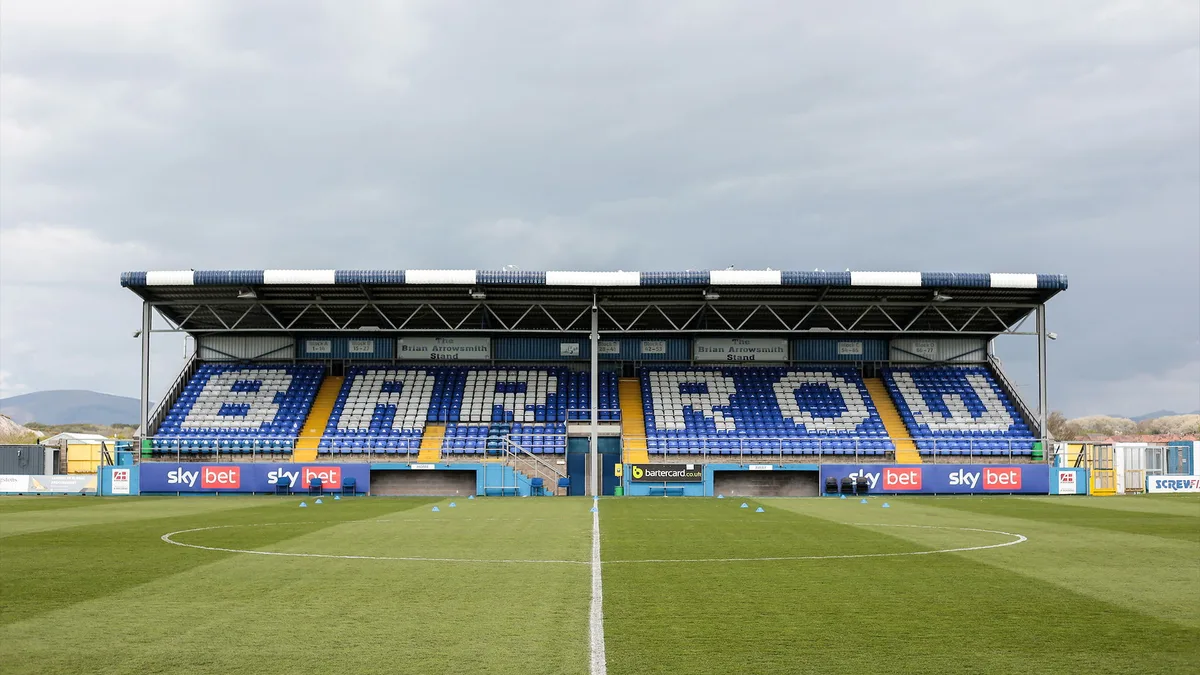
Barrow have called Holker Street their home since 1909 and is the second largest football stadium in the county of Cumbria.
With a capacity of 6,500, which includes approximately 2,250 seats, the venue has undergone transformatioanl periods throughput the years, while still retaining much of its old-fashioned character with a mix of terracing and seating.
The stadium’s most famous moment came in 1954, when a record crowd of 16,874 watched Barrow draw with Swansea Town in the FA Cup third round. Over the years, the ground has also hosted motorcycle speedway and has undergone several redevelopments while still preserving it’s historic feel.
By the 1990s, Holker Street had become rather dilapidated. The remaining stands were demolished for health and safety concerns, though a cover was retained for the “Popular Side” and terracing was pushed closer to the pitch following the removal of the speedway track.
The stadium’s most famous moment came in 1954, when a record crowd of 16,874 watched Barrow draw with Swansea Town in the FA Cup third round. Over the years, the ground has also hosted motorcycle speedway and has undergone several redevelopments while still preserving it’s historic feel.
Distance from the Sussex Transport Community Stadium: 341 Miles
Originally published by Worthing FC ↗