

Having competed in the Championship just 15 years ago, the Iron were relegated from the EFL in 2022, marking the end of a 72-year stay in English league football.
Now, following financial turmoil and board reformation in recent years, Scunthorpe will look to work their way back into the fourth tier after an unsuccessful play-off campaign ended last year’s National League season.
History
Formed in 1899, Scunthorpe United’s early existence saw the club twice crowned Midland League champions before eventually joining the Football League in 1950. The majority of Scunthorpe’s Football League tenure was spent in the Fourth Division (League Two), with the club reaching the second tier on three occasions.
Scunthorpe United most recently appeared in the Championship in the 2010/11 season, the third and final season in the second tier under the stewardship of physio-turned-manager Nigel Adkins. Adkins twice earned promotion from League One in a four year stay at Glanford Park, before departing the club for Southampton seven games into the 2010/11 Championship season.
The last decade has proved tumultuous for the club both on and off the pitch, with ownership and stadium troubles arising in the wake of Scunthorpe’s first-ever relegation to Non-League football in 2022. Withdrawal of funding by former owner David Hilton in September 2023 forced fans to take action to preserve the continuity of the football club, with an online fan-led initiative raising over £70k to help cover unpaid wages to players and staff.
In October 2023, Scunthorpe-born businesswoman Michelle Harness purchased the club ahead of their inaugural National League North campaign. It took two years for the Iron to make it back into the National League, with last season almost culminating in a return to the EFL had it not been for a play-off semi-final defeat at the hands of eventually-promoted Rochdale.
The club’s nickname, The Iron, derives from the local iron and steel industry synonymous with the town, which is also depicted in the club badge.
Manager – Andy Butler
Butler became Scunthorpe United boss on a full-time basis in 2024, with his only prior managerial experience
coming in a caretaker role at Doncaster Rovers in 2021.
A former Iron as a player, the Doncaster-born defender made over 150 appearances for Scunthorpe across two spells at the club, initially coming through their academy before making his first team debut in 2003. Butler went on to notch over 650 career appearances, turning out for the likes of Huddersfield Town, Walsall and Doncaster.
Butler took the reigns at Glanford Park following the departure of Jimmy Dean after the club were defeated in
the National League North Play-Off semi-final by Boston United in 2023/24.
The following season saw the team get over the play-off hurdle, securing the Iron’s return to the fifth tier thanks to a 2-1 extra-time victory over Chester at Glanford Park. Alongside promotion to the National League, the 2024/25 season also yielded regional success for Butler with Scunthorpe lifting the Lincolnshire Senior Cup.
Previous Meetings & Player Connections
Worthing have not played Scunthorpe United before this season, but there are three players who have appeared for both clubs: midfielder Steve Ibbitson and goalkeepers Simon Steele and Paul Musselwhite.
Stadium
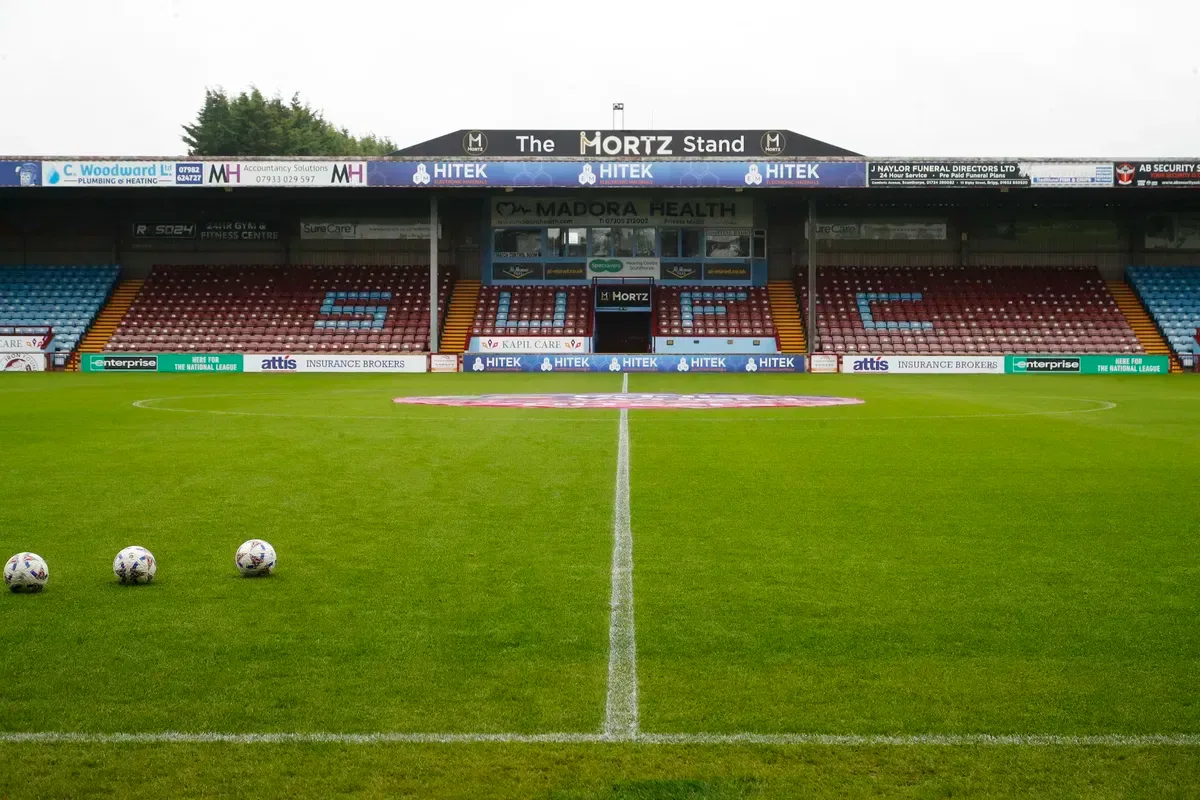
Glanford Park, known commercially as the Attis Arena, became the new home of Scunthorpe United in 1988 following their departure from the Old Show Ground – the club’s original home since their inception in 1899.
Holding a capacity of just over 9,000, the ground is made up of four single-tier stands, all bar one being fully seated.
Away fans are situated in the AMS Stand, also known as the Railway End, which boasts a capacity of 1,678. The stand’s original blue seats were acquired from Aston Villa in 1991 as part of the transfer of United defender Neil Cox to Villa Park.
Following legal disputes between previous owners regarding the ownership of the stadium itself, Glanford Park was sold to a non-profit entity named The New Show Ground Community Interest Company in November 2023, which allowed for continued use and development alongside the local council.
Distance from the Sussex Transport Community Stadium: 249 miles
Originally published by Worthing FC ↗